Cornell Develops Semiconductor Material with Record Bandgap Above 7eV
Researchers have developed silicon-doped aluminium gallium oxide with a bandgap exceeding 7 electron volts and demonstrated working transistors, opening possibilities for high-voltage power electronics and advanced photonic devices.
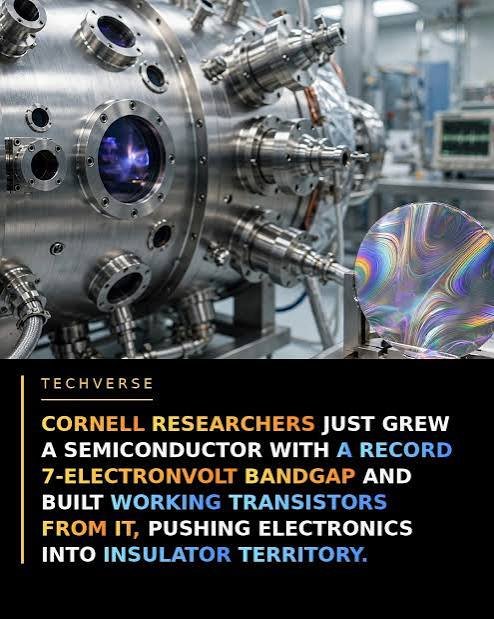
Researchers at Cornell University have developed a semiconductor material with a bandgap exceeding 7 electron volts (eV), surpassing the previous record of approximately 6eV. The material, silicon-doped aluminium gallium oxide, could support future power electronics capable of operating at higher voltages with reduced energy losses. Published in Nature on 7 October 2026, the research addresses a longstanding challenge in semiconductor development, as materials with extremely wide bandgaps often behave more like insulators. The team, led by Professor Darrell Schlom, used suboxide molecular beam epitaxy to grow thin films on sapphire substrates, incorporating silicon atoms to introduce mobile electrons and achieve controlled electrical conductivity.
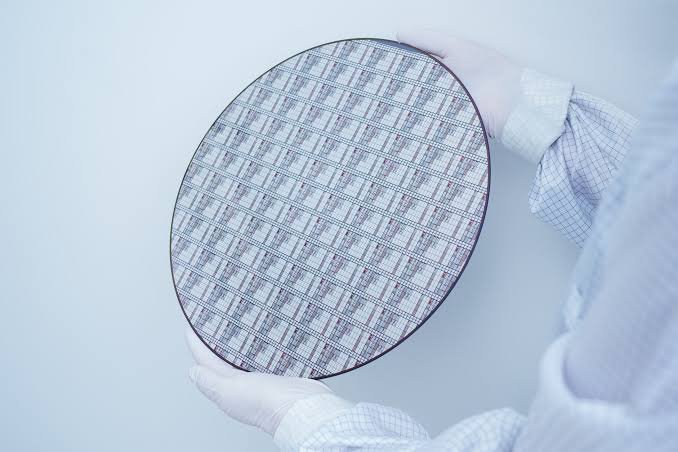
The researchers reported that the silicon-doped films achieved room-temperature conductivity more than 100 million times higher than previously demonstrated in materials with bandgaps above 6eV. Working with Professors Huili Grace Xing and Debdeep Jena, the team fabricated a diode and a field-effect transistor known as AlphaFET to demonstrate the material's electrical properties. The experimental transistor showed a change in current exceeding four orders of magnitude through gate-voltage control. The use of sapphire substrates could also offer manufacturing advantages because the material is commercially available in larger wafer sizes, although further work is required to establish production feasibility.
The development could have applications in electric vehicles, aircraft propulsion, power grids, AI data centre power systems and defence electronics, where efficient high-voltage switching is increasingly important. Researchers also identified potential uses in quantum cascade lasers and vacuum ultraviolet photonic devices. However, electron microscopy revealed a substantial number of material defects, indicating that further improvements in crystal quality, device performance and manufacturing processes will be necessary. The research was supported by the US Air Force Research Laboratory-Cornell Center for Epitaxial Solutions and the National Science Foundation. No commercial production timetable has been announced.