Memory's Comeback Year: 8 Moves by SK hynix, Samsung and Micron That Shaped 2026
05 November 2026 |
Feature
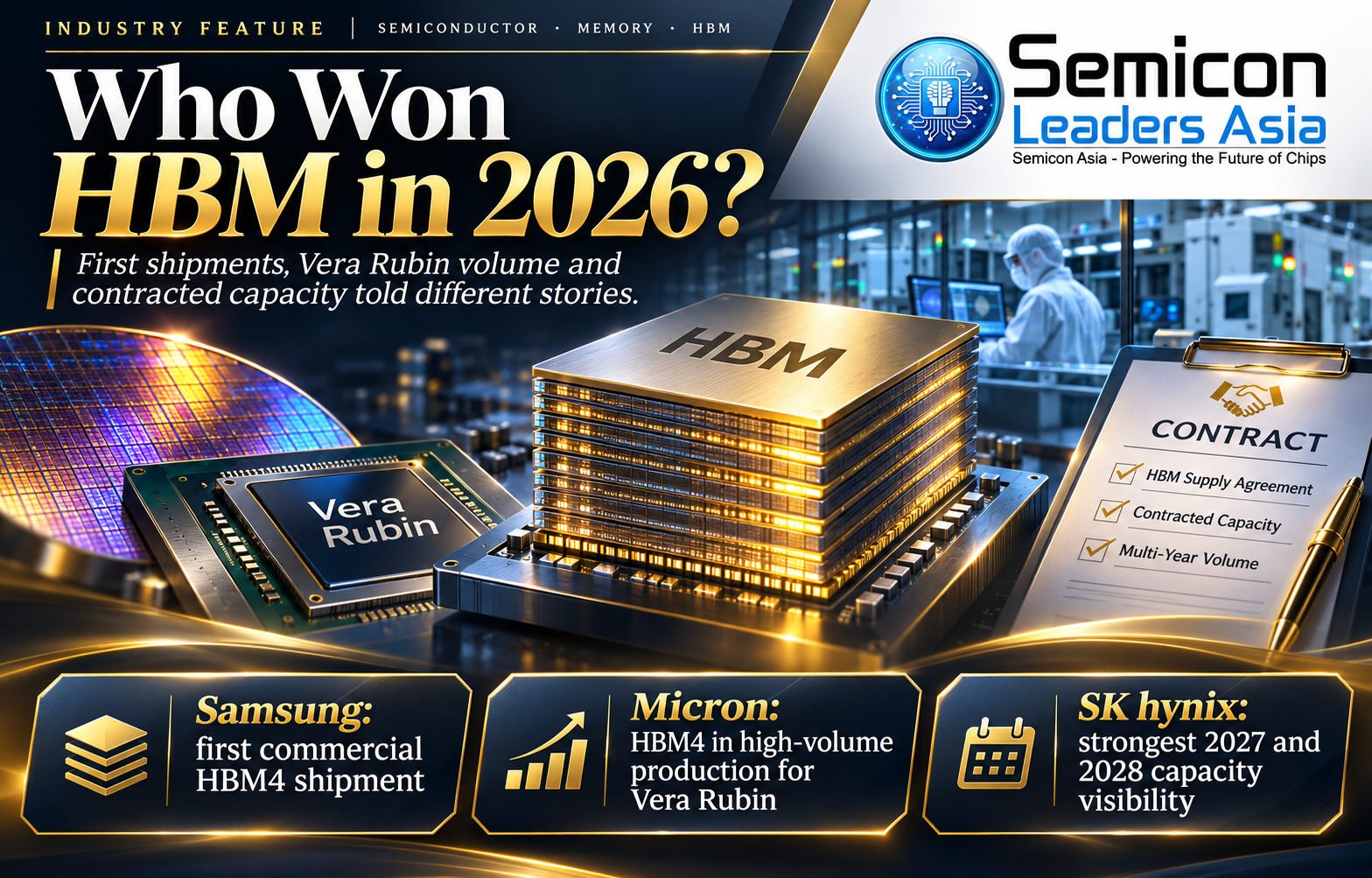
BM4 went from a qualification race to volume production in 2026. Long-term supply contracts, bonding-equipment orders and new fabs now show where the market goes next. SK hynix, Samsung and Micron can all claim a win, but each by a different measure.
Memory entered 2026 as one of the tightest constraints on the AI hardware market. It is ending the year as one of its biggest profit pools.
The third-quarter numbers make the point. SK hynix reported revenue of 104.6 trillion won and operating profit of 83.3 trillion won, a margin of roughly 80%. A day later, Samsung Electronics posted 107.4 trillion won of operating profit, the first time any technology company has crossed 100 trillion won in a single quarter, with its memory business setting another record while running short of capacity.
Higher DRAM prices explain part of that. They do not explain all of it.
Over the year, HBM4 moved into commercial production. Suppliers signed multi-year contracts that would have been unthinkable in the old boom-and-bust memory cycle. Equipment orders revealed where new HBM capacity was physically being installed. Samsung committed to a dedicated HBM fab in Korea. SK hynix approved another 54 trillion won of domestic fab investment and broke ground on a US HBM production base. Micron spent US$27.37 billion on capital expenditure in fiscal 2026 and lifted its planned US investment to more than US$250 billion through 2035.
All of which makes the question of who "won" HBM in 2026 harder to answer than a single market-share number suggests.
The three suppliers simply do not disclose comparable figures. Samsung can point to the first commercial HBM4 shipment. Micron can point to high-volume HBM4 production designed for Nvidia's Vera Rubin platform. SK hynix ends October with HBM4 ramping sharply, 14 long-term customer agreements across its wider memory business and more than half of its total 2027 and 2028 production capacity already covered by those agreements.
So rather than manufacture a league table the companies themselves do not support, Semicon Leaders Asia has tracked the eight milestones that actually moved the market. We judged them on six measures: commercial shipment, customer qualification, production equipment, contract visibility, capital expenditure and capacity being built for 2027 and beyond.
At a glance
- Samsung won the race to first commercial HBM4 shipment (12 February) and says it "significantly scaled up" HBM4 sales in Q3.
- Micron tied HBM4 high-volume production directly to Nvidia Vera Rubin and locked in 16 five-year strategic customer agreements.
- SK hynix finishes the year with the strongest forward visibility: 14 long-term agreements covering more than 50% of 2027 and 2028 capacity.
- The 2027 contest is no longer about qualification. It is about delivering reliable, high-yield volume against contracts already signed.
1. 14 January: SK hynix starts the year by ordering more HBM bonding equipment
What happened
Hanmi Semiconductor disclosed a 9.65 billion won contract with SK hynix for thermo-compression (TC) bonders, with delivery due by 1 April. TC bonders stack DRAM dies into HBM packages, so the order was an early physical sign that SK hynix was preparing additional advanced-memory capacity. The market widely linked it to next-generation HBM production.
Why it matters
Product roadmaps tell investors what a supplier intends to make. Equipment orders show when that intention starts turning into factory capacity.
In HBM, that distinction is critical. Wafer output alone is not enough: die stacking, bonding, packaging and test capacity all have to grow in step.
What to watch in 2027
Track repeat bonding-equipment orders and where those systems are installed. Capacity commitments made several quarters ahead of finished shipments are among the clearest signals of how hard a supplier expects HBM demand to grow.
2. 12 February: Samsung claims the first commercial HBM4 shipments
What happened
Samsung Electronics announced mass production and commercial shipments of HBM4. The product pairs sixth-generation 10nm-class (1c) DRAM with a 4nm logic base die. Samsung quoted a consistent transfer speed of 11.7Gbps, with headroom to 13Gbps.
Why it matters
For Samsung, this was more than a product launch.
The company spent much of the previous HBM cycle trying to close the gap between its vast DRAM manufacturing base and its position in the highest-value AI memory segment. Shipping HBM4 commercially gave it something it badly needed: proof that the new generation would not repeat the timing problems of the last one.
Samsung's first-quarter presentation then confirmed it had begun mass-product sales of HBM4 for Nvidia's Vera Rubin platform.
What to watch in 2027
Commercial shipment was only the first test. The harder ones are sustained volume, yield and how many large accelerator customers qualify Samsung's HBM4 and HBM4E. Samsung's 29 October third-quarter results confirmed that HBM4 sales had been "significantly scaled up", but the company again stopped short of naming customers or disclosing HBM volumes.
3. 16 March: Micron turns HBM4 into a Vera Rubin production programme
What happened
Micron announced that its 36GB 12-high HBM4 had entered high-volume production for Nvidia's Vera Rubin platform. The company said the part delivers more than 2.8TB/s of bandwidth and over 20% better power efficiency than its HBM3E implementation.
It also said it had shipped customer samples of a 48GB 16-high HBM4 product, demonstrating its ability to stack 16 DRAM dies.
Why it matters
Micron's 2026 HBM story was about turning a smaller overall DRAM footprint into a stronger position at the very top of the memory market.
The Vera Rubin disclosure carries weight because it links production directly to a named accelerator platform, not to a generic qualification programme.
What to watch in 2027
Micron expects HBM4E, built on its 1-gamma DRAM technology, to enter volume production in calendar 2027. The key question is whether qualification widens from the lead platform to a broader group of accelerator and custom-silicon customers.
4. 8 June: The SK hynix equipment order gets much larger
What happened
Hanmi Semiconductor disclosed a second SK hynix TC bonder contract, this time worth approximately 44.2 billion won.
The order covered Hanmi's TC Bonder 4.5 Griffin systems for HBM4 production, with supply running into September. It was more than four times the value of the January contract. Hanmi later told investors that rising HBM4 investment by global memory makers was lifting TC bonder demand.
Why it matters
This is one of the most useful milestones of the year because it measures the HBM race from the supply chain, not the press release.
A memory maker can announce qualification without committing to much new capacity. A follow-on equipment order four times larger suggests the manufacturing ramp has moved into a different gear.
Notably, the June order landed before SK hynix confirmed, in its second-quarter results, that HBM4 mass shipments had begun.
What to watch in 2027
Watch the HBM equipment ecosystem, not just the memory makers. Bonding, inspection and test contracts can reveal where capacity is heading before bit-output guidance catches up.
5. 24 June: Micron rewrites the memory contract model
What happened
With its fiscal third-quarter results, Micron disclosed 16 Strategic Customer Agreements (SCAs) spanning data-centre, consumer and automotive customers.
The agreements typically run for five years, from 2026 to 2030, and represent roughly 20% of Micron's DRAM volume and one-third of its NAND volume over that period. Its regulatory filing says they use take-or-pay commitments for specified volumes, often with fixed prices or price bands.
In the same announcement, Micron said HBM4 was already in high-volume shipments for its lead customer's platform and that qualification samples had gone to multiple end customers.
Why it matters
These are not HBM-only agreements, and they should not be read as such.
What they do show is how far the AI memory shortage has shifted bargaining power. Customers now value guaranteed supply enough to accept multi-year volume commitments and pricing structures that would have been unusual in the old commodity DRAM model.
What to watch in 2027
The question is whether long-term contracting spreads further into HBM and server DRAM. If it does, memory earnings could become structurally less cyclical, even before new fabs meaningfully ease supply.
6. 29 July: SK hynix confirms HBM4 mass shipments and multi-year demand visibility
What happened
SK hynix said HBM4 mass shipments had begun in the second quarter and would ramp further through the second half.
It also disclosed long-term agreements with around 10 key customers, with further multi-year negotiations under way. HBM4E samples had already shipped in the first half.
Why it matters
This was the moment SK hynix's 2026 HBM story shifted from product announcements to execution.
The company was shipping HBM4, sampling its successor and negotiating multi-year supply, all at once. That combination matters far more than holding the fastest headline specification.
What to watch in 2027
Watch how much HBM4 output the new M15X fab in Cheongju can deliver and how quickly production migrates to the 1c DRAM process. The competitive measure that counts is contracted, high-yield volume, not sample announcements.
7. 30 July: Samsung shows its HBM4 launch is scaling, then moves to HBM4E
What happened
Samsung's second-quarter results reported another record quarter for its Memory Business, achieved while operating with limited capacity.
The company said it had scaled up HBM4 sales and shipped what it called the industry's first HBM4E samples to major customers. It expected server DRAM, enterprise SSD and HBM demand to accelerate in the second half, leaving the market undersupplied.
Why it matters
February established Samsung's HBM4 timing. July delivered the more important signal: the product had moved beyond launch volumes while its successor was already in customer hands.
The capacity story backed it up. In June, Samsung set out plans for roughly 2,100 trillion won of semiconductor investment through 2040 under its Korean investment vision, including a new HBM fab in Onyang, Cheonan. Its March corporate-value plan had already put 2026 facilities and R&D investment above 110 trillion won.
What to watch in 2027
Samsung's biggest open question is customer breadth.
Its third-quarter outlook says AI-driven demand in 2027 will "far exceed" industry supply and that it intends to build "a stable sales base by securing multi-year contracts". If HBM4E qualifications convert into large production contracts on that basis, Samsung's manufacturing scale becomes a formidable advantage.
8. 28 October: SK hynix enters 2027 with capacity already contracted
What happened
SK hynix's third-quarter results delivered the clearest forward signal of the year.
The company said HBM4 shipments had expanded sharply and that HBM4 would overtake HBM3E in both shipment volume and revenue in the fourth quarter, making it the company's mainstream HBM product.
More significantly, SK hynix now holds long-term agreements with 14 major customers, including global cloud service providers. Contracted volume covers more than 50% of its total production capacity for both 2027 and 2028, and the company says its HBM and DRAM output is effectively sold out through 2029. These are company-wide memory agreements rather than an HBM-only figure, but they give unusually strong visibility into future demand.
Why it matters
This is where the HBM race and the wider memory cycle converge.
SK hynix is not just adding HBM output. It is entering the next investment cycle with a large share of future capacity already backed by multi-year customer commitments, and with management guiding that supply will trail demand through 2030.
The company also plans to run M15X at full capacity by year-end and expects investment to rise significantly in 2027 as Yongin Phase 1 and other infrastructure come online.
What to watch in 2027
The test is whether contracted demand translates into sustained HBM margins as competitors add supply.
SK hynix's edge today is not HBM technology alone. It is the combination of HBM4 volume, capacity expansion and customer visibility.
The 2026 HBM scorecard
|
Measure
|
SK hynix
|
Samsung Electronics
|
Micron
|
|
HBM share signal
|
Strongest disclosed mix of HBM4 ramp and forward contract visibility; no comparable company-disclosed HBM share
|
First commercial HBM4 shipment; HBM4 sales "significantly scaled up" in Q3
|
High-volume HBM4 tied directly to lead customer's Vera Rubin platform
|
|
HBM4 status
|
Mass shipments from Q2; HBM4 set to exceed HBM3E in shipments and revenue in Q4
|
Commercial shipments from 12 Feb; sales scaled up through Q2 and Q3
|
36GB 12-high HBM4 in high-volume production from Q1
|
|
Next-generation signal
|
HBM4E samples shipped in H1
|
HBM4E samples shipped to major customers in Q2
|
HBM4 qualification samples to multiple end customers; HBM4E volume planned for 2027
|
|
Contract visibility
|
14 LTAs covering over 50% of total 2027 and 2028 capacity
|
Targeting multi-year contracts for 2027; no comparable contracted-capacity figure disclosed
|
16 SCAs covering about 20% of DRAM and one-third of NAND volume over their terms
|
|
2026 investment signal
|
54 trillion won approved for Yongin Y2 and Cheongju M17
|
More than 110 trillion won for 2026 facilities and R&D
|
US$27.37 billion FY2026 net capex
|
|
New capacity
|
Y2 and M17 in Korea; more than US$4 billion Indiana HBM and packaging project
|
HBM fab planned in Onyang, Cheonan, within wider Korean investment programme
|
More than US$250 billion planned US investment through 2035; New York construction under way
|
|
What matters in 2027
|
Turning contracted demand into high-yield HBM4 and HBM4E volume
|
Converting HBM4 and HBM4E qualifications into wider customer share
|
Expanding beyond lead-customer HBM4 volume while executing new capacity
|
Source note: Contract figures for SK hynix and Micron cover wider memory production, not HBM alone. They are used here as demand-visibility signals, not as HBM market-share figures.
Semicon Leaders Asia view
Company disclosures alone do not support a single-number answer to who won HBM in 2026.
They do support answers by measure.
Samsung won the first-shipment milestone. Its February HBM4 launch put it into commercial production early, its July HBM4E samples showed the roadmap moving quickly, and its third-quarter results confirmed HBM4 sales scaling significantly.
Micron produced the clearest customer-specific HBM4 signal. Its product entered high-volume production for Nvidia Vera Rubin, while qualification widened to additional customers and its strategic agreements locked in multi-year demand.
SK hynix finishes the year with the strongest combination of HBM4 momentum and forward demand visibility. HBM4 becomes its mainstream HBM product in Q4, and long-term agreements now cover more than half of total production capacity for 2027 and 2028. That does not prove a precise HBM market share, but it is a powerful commercial signal.
The bigger story for 2027 is that the nature of the competition has changed.
The three suppliers are no longer fighting only for qualification. They are competing on who can turn qualified HBM into reliable volume while financing the cleanrooms, bonding equipment, advanced packaging and new fabs the next cycle demands.
That is why the Hanmi contracts belong alongside the HBM4 announcements. And it is why SK hynix's LTAs, Micron's strategic customer agreements and Samsung's new HBM capacity matter more than another bandwidth claim.
Memory's comeback year was never just a pricing recovery.
In 2026, memory became contracted infrastructure for AI. In 2027, the advantage will belong to the supplier that can actually deliver against those contracts.
Sources
- https://news.samsung.com/global/samsung-ships-industry-first-commercial-hbm4-with-ultimate-performance-for-ai-computing
- https://investors.micron.com/news/press-release/2026/Micron-in-High-Volume-Production-of-HBM4-Designed-for-NVIDIA-Vera-Rubin-PCIe-Gen6-SSD-and-SOCAMM2-03-16-2026/default.aspx
- https://investors.micron.com/overview/default.aspx
- https://investors.micron.com/news/press-release/2026/Micron-Technology-Inc--Reports-Record-Results-for-the-Third-Quarter-of-Fiscal-2026/default.aspx
- https://news.skhynix.com/en/q2-2026-business-results/
- https://news.samsung.com/global/samsung-electronics-announces-second-quarter-2026-results
- https://news.skhynix.com/en/fab-facility-investment-2026/
- https://www.samsung.com/global/ir/reports-disclosures/public-disclosure-view.84599/
- https://www.samsung.com/global/ir/reports-disclosures/public-disclosure-view.84685/
- https://investors.micron.com/news/press-release/2026/Micron-Technology-Inc--Reports-Record-Fiscal-Fourth-Quarter-and-Full-Year-2026-Results/default.aspx
- https://investors.micron.com/news/press-release/2026/Micron-Accelerates-U-S--Investments-Pours-First-Concrete-at-New-York-Fab/default.aspx
- https://news.skhynix.com/en/q3-2026-business-results/
- https://www.samsung.com/global/ir/reports-disclosures/public-disclosure-view.84776/
- https://news.samsung.com/global/samsung-electronics-announces-third-quarter-2026-results
- https://www.koreatimes.co.kr/business/companies/20261028/sk-hynix-logs-record-q3-operating-profit-of-628-bil