Sony Targets Semiconductor and Battery Inspection Markets with IMX711 Sensor
New X-ray imaging technology improves measurement accuracy, throughput and analytical capabilities.
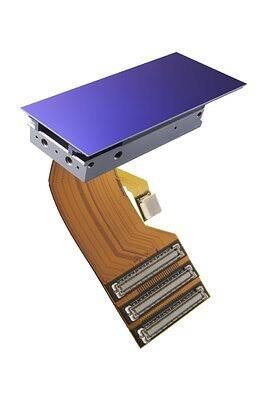
Sony Semiconductor Solutions Corporation (Sony) announced the upcoming release, mass production, and shipment of the IMX711 direct conversion charge-integrating X-ray CMOS image sensor.
The IMX711 is an X-ray image sensor for inspection and measurement instrumentation which directly detects X-rays and outputs signals proportional to their energy. The new sensor offers the industry's fastest*1 maximum 26,100 fps high-speed imaging, achieved thanks to Sony's proprietary circuit technology, suppressing charge saturation for accurate measurements. It also significantly reduces noise to enable improved signal detection precision in low-flux conditions, detecting differences in photon energy. It provides both high-accuracy measurements of integrated X-ray energy at a wide dynamic range and energy information acquisition at the photon level on a single sensor, a feat that has been difficult with conventional sensors. This unique feature will contribute to the advancement and diversification of X-ray inspection and measurement technologies, which are used in a wide variety of applications, from cutting-edge device inspection to scientific measurements.
The IMX711 was developed with the collaboration between Sony Semiconductor Solutions Corporation and RIKEN. Based on a pixel structure invented by Dr. Takaki Hatsui of RIKEN, the two parties worked together on the technological development required to make it viable as a practical X-ray image sensor, including improving sensitivity and achieving high resistance to X-ray irradiation and high-voltage tolerance. Sony developed its circuit technology, manufacturing processes and packaging technology for mass production.
X-ray inspection and measurement are widely used in a variety of fields, including inspection of advanced devices such as batteries and semiconductors, and scientific measurement in materials development and life sciences research. As these methods become more sophisticated, along with advances in data analysis technology, including AI, X-ray sensors are also required to evolve to deliver more efficient and highly reliable data acquisition. However, with conventional sensors,*3 it has been challenging to improve measurement accuracy and meet the requirements of diversifying downstream analysis, due to the photon counting errors in high-flux conditions and the impact of noise under low-flux conditions.
The new sensor enables the industry's fastest*1 maximum frame rate of 26,100 fps and low-noise performance of 34 e-rms*4 (random noise of approximately 34 electrons per pixel), thereby helping to resolve the above-mentioned technical challenges. It not only accurately detects signals across a wider dynamic range than conventional sensors but also resolves photons of varying energy levels at high resolution while offering the advantage of a charge-integrating sensor to output both integrated X-ray energy data and photon energy data. The highly reliable data acquired by this product will not only improve the performance of X-ray inspection and measurement equipment but also contribute to the development of new analysis methods using energy information, as described below.
Examples of Potential Applications
- Improving precision and throughput in high-speed inspection of moving objects for battery and semiconductor applications
- Elemental mapping for distinguishing photons of different energy levels and rendering a two-dimensional distribution
- Simultaneous measurement of crystal structure analysis and element analysis using photon energy information and spatial information
Main Features
- High-accuracy measurements in a wide dynamic range thanks to the industry's fastest,*1 low-noise imaging
This product achieves the industry's fastest*1 maximum frame rate of 26,100 fps thanks to Sony's proprietary circuit technology. Lowering the accumulated charge per frame yields superior saturation characteristics compared to conventional sensors. At the same time, random noise, which is a technical challenge on charge-integrating sensors, has been reduced to 34 e-rms*4 so that even faint X-ray signals are not obscured by noise and can be reliably detected. This improves measurement precision under low-flux conditions, offering photon-level detection. These features enable accurate measurement of integrated X-ray energy for all pixels across low- to high-flux conditions, supporting inspection and measurement with significant differences in brightness on a single sensor, contributing to improved device throughput and an expanded dynamic range.
- High energy resolution enabling inspection and measurement using photon energy
The new sensor uses the charge-integrating method, which makes it possible to acquire photon energy information without the need to set a threshold in advance. Furthermore, noise and signal variation are suppressed during reading to achieve high energy resolution for clear identification of differences in photon energy. Enabling the acquisition of highly reliable data via high energy resolution will contribute to streamlining and improving precision in advanced inspection and measurement, which previously required several measurements in applications such as detecting differences in constituent elements at the element level and structural and material analysis to quantitatively evaluate minute state changes. It also enables post-processing under various conditions, such as collecting the measurement data for all pixels, combining it with spatial information, and extracting specific energy data, which contributes to multifunctional inspection and measurement.