Toshiba Electronic Devices & Storage Corporation Launches SmartMCD Motor Control Device for Automotive Electrification
New TB9M030FG integrates MCU and motor driver with sensorless control to enable compact, efficient, and quieter automotive systems.
Toshiba Electronic Devices & Storage Corporation (“Toshiba”) has begun shipping engineering samples of “TB9M030FG,” the latest addition to its “SmartMCD™”[1] series of motor control devices. The new device integrates a microcontroller (MCU) and a motor driver, and incorporates sensorless control technology for low‑speed operation of three‑phase brushless DC motors. TB9M030FG is suitable for sensorless control of the three‑phase brushless DC motors used in automotive applications, such as electric water pumps, electric oil pumps, electric fans, and electric blowers.
As the electrification of automotive systems such as water pumps, oil pumps, and fans continues, automobile makers want more compact, more efficient and quieter motors. Alongside this, with increasing numbers of electronic control units (ECUs)[2] installed in vehicles, lowering component counts and minimising board space have become increasingly important, and are driving growing demand for highly integrated devices that combine an MCU and a motor‑control gate driver.
Sensorless control of three‑phase brushless DC motors presents the challenge of accurate detection of rotor position at low speeds, creating strong demand for high‑performance sensorless field-oriented control (FOC)[3] technology that delivers stable control from zero speed[4].
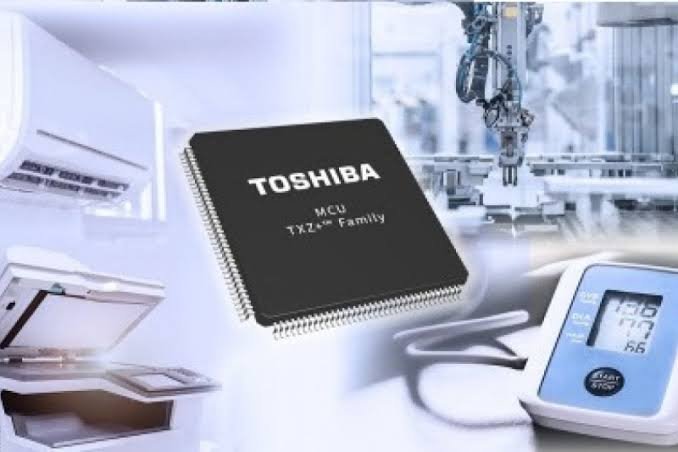
TB9M030FG integrates an Arm® Cortex®‑M0 core-based MCU, flash memory, a gate driver that controls and drives N‑channel power MOSFETs for three‑phase brushless DC motor operation, a local interconnect network (LIN)[5] transceiver, and a power system that can operate at automotive battery levels—all in a small 9×9mm (typ.) QFP48 package. This integration contributes to ECU miniaturisation and lower component counts.
The new MCD also incorporates Toshiba’s proprietary vector engine hardware, which reduces CPU workload and software program size in FOC motor‑control applications. Toshiba’s sensorless control technology, developed for low‑speed operation, enables position‑sensorless FOC control from zero speed through low speeds when used with salient‑pole motors[6]. This approach eliminates the noise generated by the standard high-frequency signal injection method[7], caused by harmonic injection, and also leads to quieter motor operation.
TB9M030FG complies with the automotive electronics qualification standard AEC‑Q100[8] (Grade 0).
The characteristics of the TB9M030FG contribute to the miniaturisation of automotive systems and lower component counts while enabling more advanced and sophisticated motor-control, and making it suitable for a wide range of automotive motor applications.
Toshiba will continue to expand the lineup of its SmartMCD™ series by incorporating the functions required for automotive systems, thereby contributing to the miniaturisation of automotive systems and lower component counts.
Applications
Automotive equipment
- Electric water pumps
- Electric oil pumps
- Electric fans
- Electric blowers, etc.
Features
- Sensorless control gate driver IC for three-phase brushless DC motors (built-in charge pump circuit)
- 32-bit MCU (Arm® Cortex®‑M0) with 40 MHz operating frequency (built-in low‑speed and high‑speed oscillators)
- Built-in memory with ECC[9]
Code flash: 64KBytes; ROM: 12KBytes; RAM: 4KBytes
- Built‑in vector engine (VE) for FOC control and programmable motor driver (PMD)[10]
- Built-in 1-shunt resistor current sense amplifier[11], 12-bit A/D converter, and 10-bit A/D converter
- Enables position‑sensorless FOC control from zero speed through the low‑speed operating range when used with salient‑pole motors