MIPS to Showcase RISC-V Innovation and Physical AI Advances at Chiplet Summit 2026
Company leaders to present on safety-critical AI applications, software-first design, and chiplet optimization strategies for next-generation edge computing.
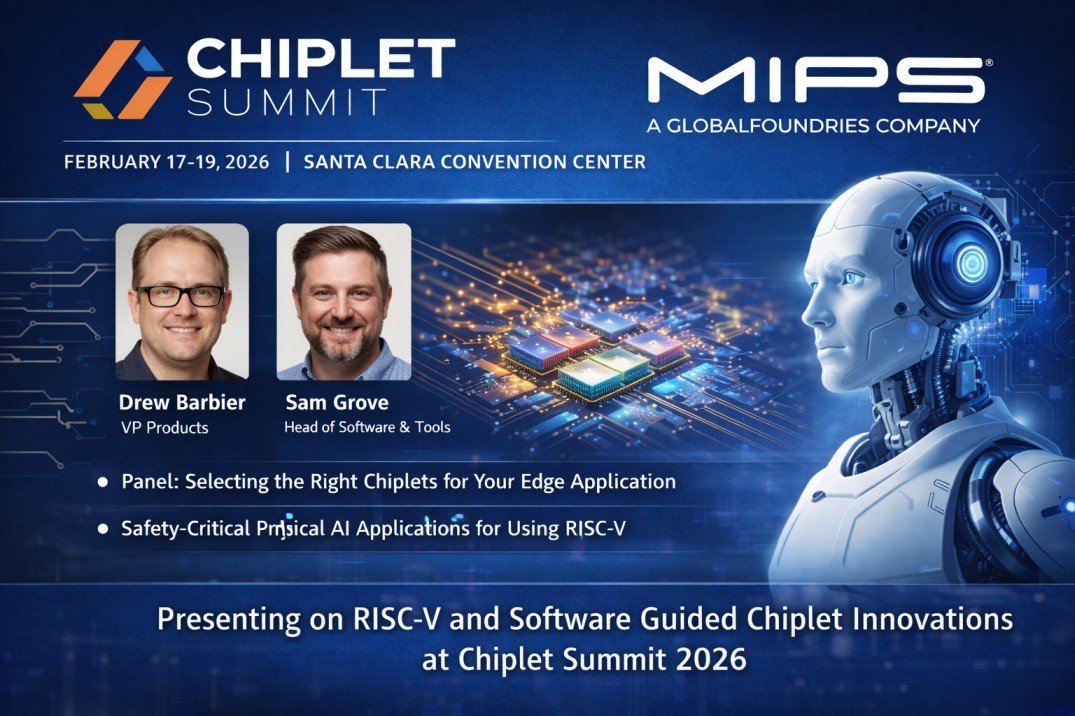
Chiplet Summit, the industry’s largest chiplet event, today announced that MIPS, a GlobalFoundries company, will participate in Chiplet Summit 2026, February 17-19 at the Santa Clara Convention Center.
Drew Barbier, VP Products at MIPS, will deliver a presentation titled “Safety-Critical Physical AI Applications Using RISC-V.” He will also be on the panel “Selecting the Right Chiplets for Your Edge Application.” In addition, Sam Grove, Head of Software and Tools, will present on “Software Guided Intelligence for Accelerating Chiplet Designs.”
“We look forward to attending the 2026 Chiplet Summit as it brings key players in the semiconductor ecosystem, as well as serves as the ideal venue to discuss how RISC-V processors and software are critical to the next generation of physical AI applications,” said Barbier. “Our sessions will explore software-first platform design and how chiplets enable workload-specific customization, leveraging the MIPS Atlas portfolio.”
MIPS’ participation highlights the growing role of RISC-V processors in chiplet-based platforms for automotive, industrial, and embedded AI markets.
“Processor decisions play a key role in system design,” said Chuck Sobey, General Chair of Chiplet Summit. “MIPS’ leadership will offer our attendees the insights they need to adopt software-first RISC-V designs across a wide array of applications.”
“A software-first approach is the foundation of modern system design,” said Grove. “At MIPS, we are enabling a 'shift-left' methodology through digital twin platform modeling with the MIPS Atlas Explorer, delivering data-driven insights into workload behavior and pre-silicon validation. As the demand for high-performance, domain-specific compute accelerates, the ability to analyze and optimize interactions between workloads and customizable compute platforms becomes a true competitive advantage.”