Olivier Blachier of Entegris on Accelerating Next-Generation EUV Adoption Through Materials Innovation and Industry Collaboration
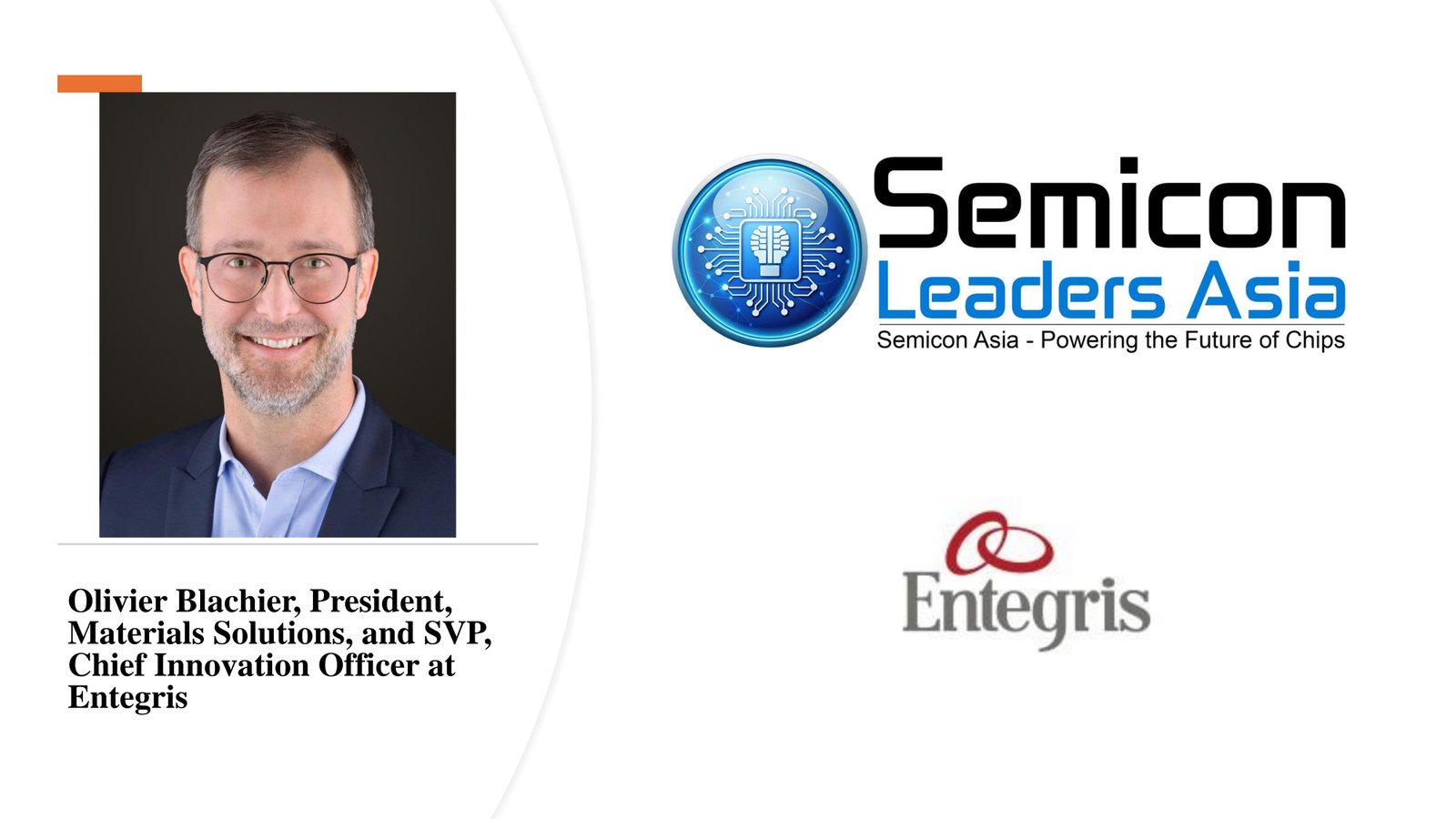
Olivier Blachier, President, Materials Solutions, and SVP, Chief Innovation Officer at Entegris, discusses the growing role of ecosystem partnerships, Metal Oxide Resist (MOR) technologies, and advanced materials integration in enabling high-volume EUV manufacturing and future semiconductor scaling.
Q. This cross-licensing agreement reflects a growing trend of ecosystem-level collaboration in semiconductor materials innovation. How important are strategic partnerships in accelerating the adoption of next-generation EUV lithography technologies?
Entegris is involved in multiple EUV-related development & partnership programs for current EUV technology, but also for high-NA EUV. For example, our filtration & purification business units collaborate with photoresist manufacturers in selectively removing impurities for next-generation CAR resist materials; our Microenvironment & Fluid Management business unit also collaborates in developing high-purity containers & flow management solutions to store and to dispense these same resist materials to the OEM track tools. Similarly, we have developed next-generation EUV Pods to transport and protect EUV troubles (photomasks). All these developments are therefore made in collaboration with Photoresist material suppliers and OEMs.
Q. Metal oxide resists are becoming increasingly critical for advanced node manufacturing. What technical or manufacturing challenges does this collaboration aim to address for semiconductor customers moving toward high-volume EUV production?
Metal Oxide Resists are critical for next-generation EUV as they can help overcome the physical limitations of traditional polymer-based CAR resists, by providing higher resolution, structural integrity and etch resistance; MORs enable higher EUV photon absorption, the elimination of acid blur, a superior Line edge Roughness, high Etch selectivity and can also help mitigate Pattern collapse.
Q. The agreement combines expertise across resist chemistry, precursor development, filtration, and materials handling. How does integrating these capabilities improve process reliability and yield for advanced semiconductor fabrication?
As indicated above, MOR materials require careful handling, ultra-high purity control, careful handling and distribution from manufacturing to packaging to delivery to the wet or plasma-based process tool; the collaboration anticipates working on all these aspects.
Q. As AI-driven demand pushes the industry toward smaller process nodes and higher performance requirements, how do you see MOR technologies evolving over the next several years?
MOR is expected to be widely adopted by the industry in DRAM (likely 1c nm node), Logic (likely at/around 10A logic node), and high-layer-count NAND for patterning deep vertical layers once devices start approaching 400-500L; adoption will be driven by its inherently lower EUV exposure dose, reduced LER, and process cost effectiveness.
Q. Entegris and Inpria are also exploring future collaboration opportunities beyond patent cross-licensing. Could this agreement serve as a foundation for broader innovation initiatives across advanced semiconductor materials and process integration?
Entegris believes that collaboration across semiconductor material companies and fab process integration will be key to success in the future, and more partnerships of this type are likely to emerge in order to unlock next-generation device architecture materials adoption.
Q. With semiconductor manufacturers prioritising supply chain resilience and process consistency, how important is close cooperation between materials suppliers and lithography ecosystem partners in enabling long-term industry scalability?
Collaborations between 2 industry leaders in Photoresist materials (for JSR) and in Deposition & Etch materials (for Entegris) are essential to accelerating new materials adoption by the IDMs & foundries, as well as continued engagement of the broader Lithography ecosystem partners.